How The Internet Killed The Adult Magazine
In the past, there was a time when the adult magazine was the main focus of the erotic industry. Anyone who wanted to see beautiful nude models had to go to a newsstand, pick up a copy of Playboy or Penthouse, or order it to their doorstep through a subscription. These magazines made models the stars of that period, and photographers who captured their images became legends as magazines sold millions of copies every month.
Today, most of these magazines are either gone, or they have become much smaller in size compared to their prime time. In most cases, they are only available online. This happened due to the appearance of the internet and its becoming more available all over the globe. The internet did not just compete with them, but it changed the way people find and enjoy erotic photography. Because of that, we are going to look at how adult magazines rose to the top, what exactly happened when the internet showed up, and what the magazines left behind once the galleries replaced them.
The Golden Age Of The Adult Magazine
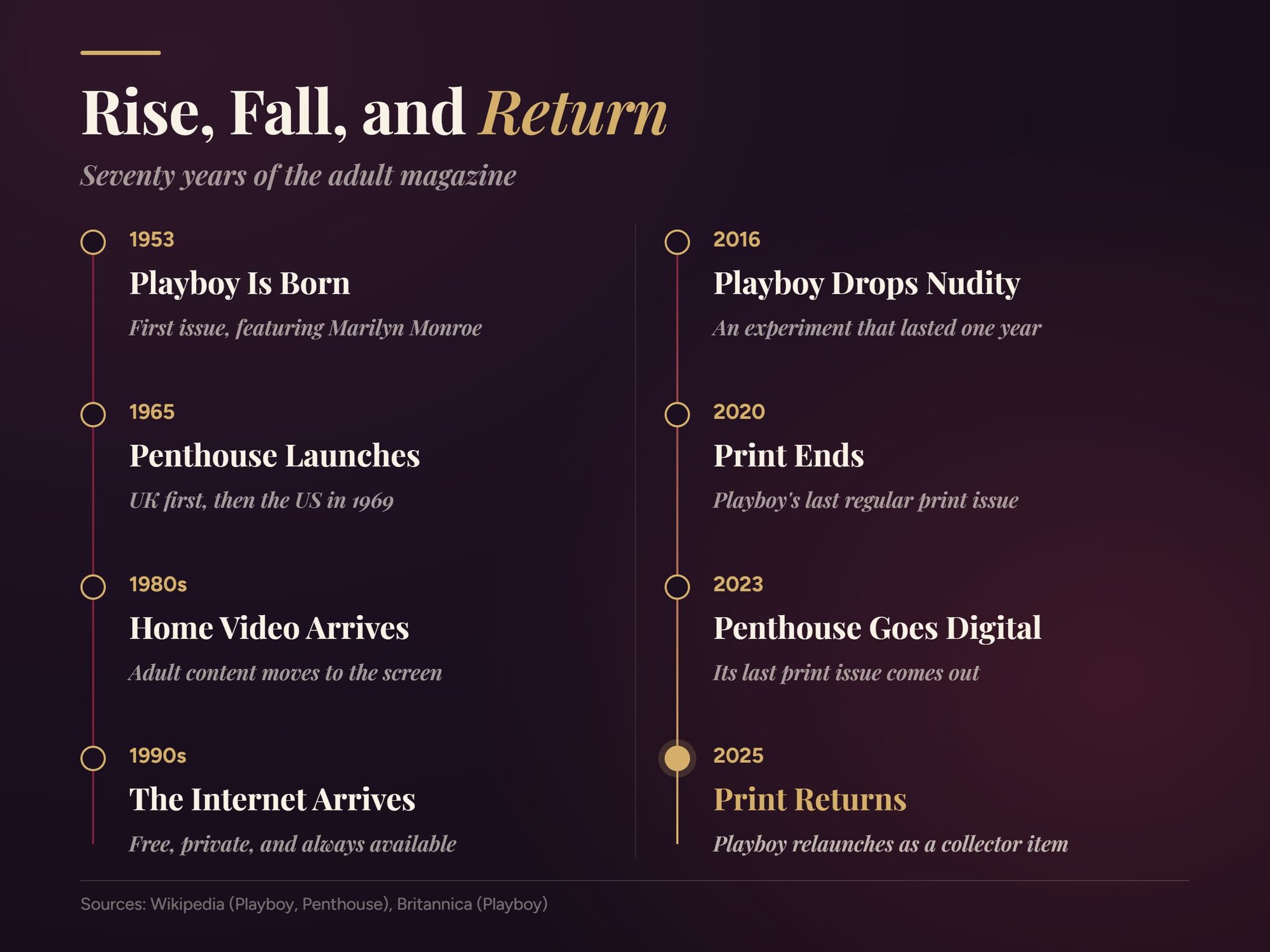
When it comes to the modern adult magazine that most people think of, it might come as a surprise, but it started in 1953 when Hugh Hefner put together the very first issue of Playboy in Chicago. According to Britannica, that first issue used a previously unpublished nude calendar photo of Marilyn Monroe, and it was an instant success. From there, Playboy grew into one of the most famous brands in the world, which, as a brand, is a position it still holds today.
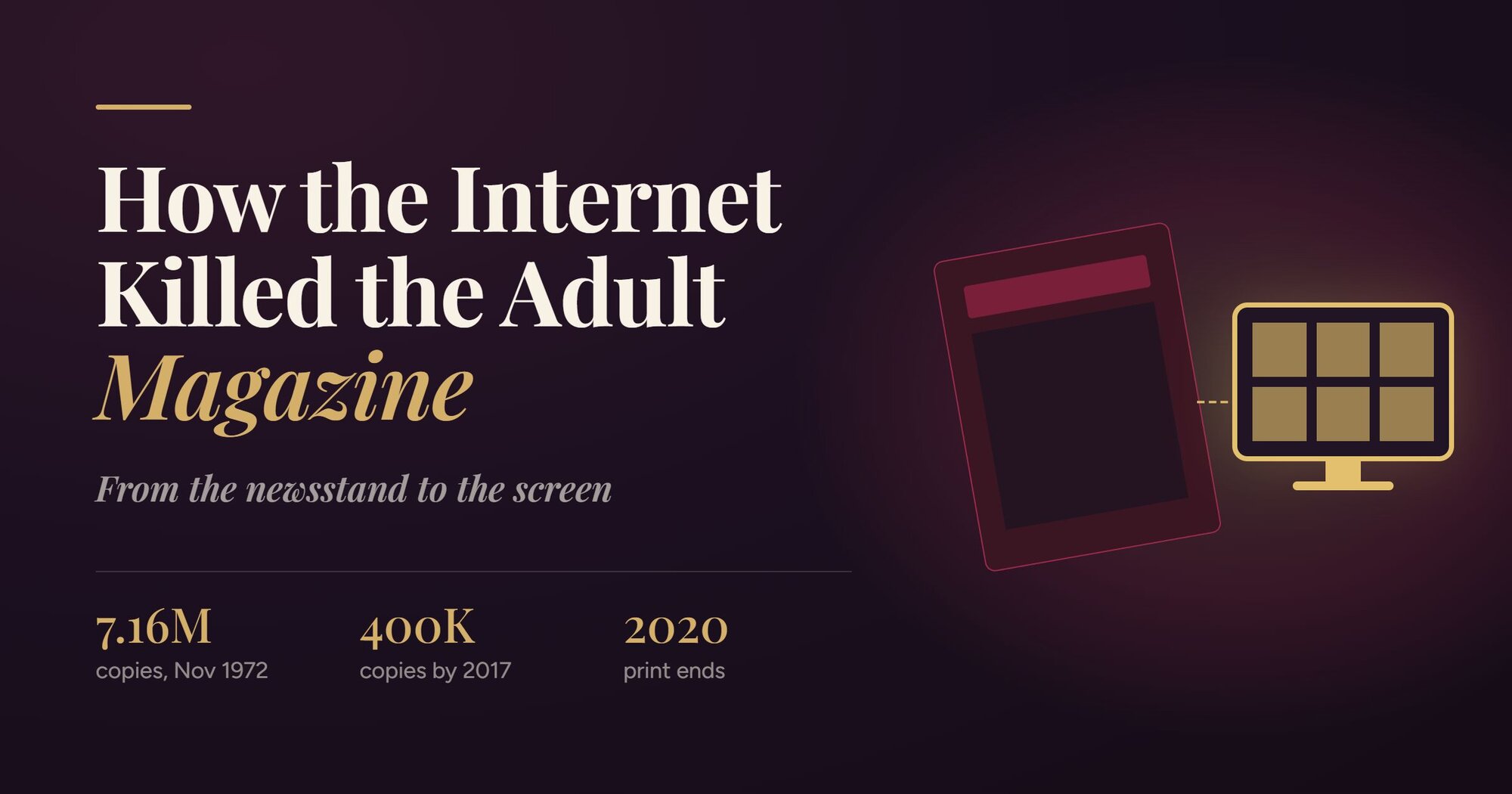
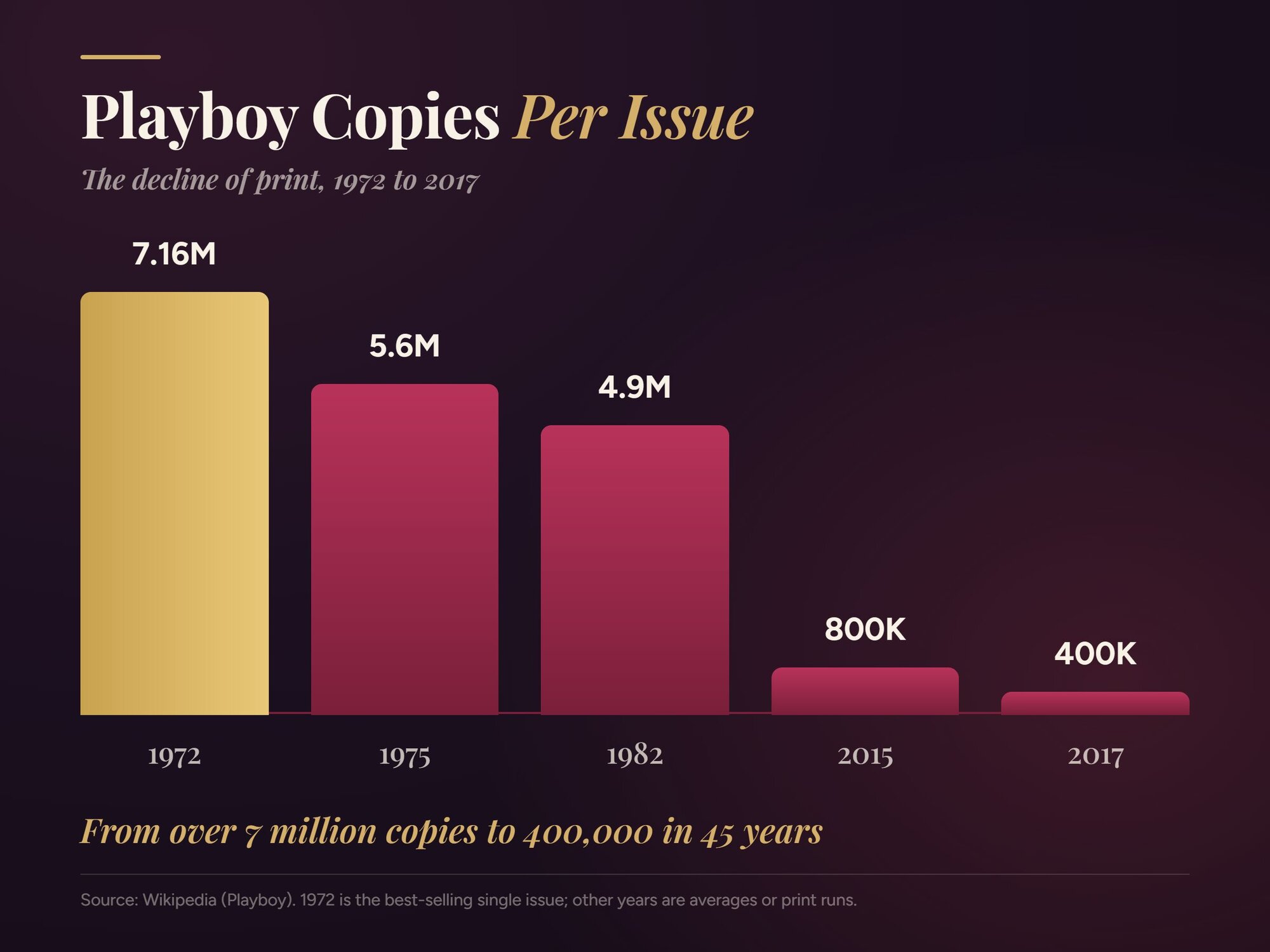
During its peak, the numbers that Playboy was reeling in were huge. In the early 1970s, it reached a circulation of around seven million copies, with its best-selling issue being the one from November 1972 with over 7.1 million sales. It did not take long for other magazines to start popping up. Penthouse launched in the United Kingdom in 1965, and it came to the United States in 1969. It was the first time that Playboy had a worthy rival, and as always, where there is competition, the content for the readers only became better.
For decades, these magazines were something where most people saw professional nude photography for the very first time, and being featured in one of these magazines would make the model a cultural icon. This is especially the case for those who were named Playmate, a featured model of the month, which opened doors for such models to all kinds of other media like filming, television, and modeling in non-adult content. Being a Playmate was such a big deal that even today, some of the older Playmates have thousands of fans, and their work can still be found within the Playboy Playmate galleries.
Why Magazines Worked So Well
While many would say that these magazines succeeded only because there were no other options at the time, this is not entirely true, and there is more to that story. Adult magazines were actually really good at what they did. Curation was the main element behind that, as editors picked the best models, the best photographers, the best images, and the readers trusted them to deliver content that was actually worth paying for. Every issue felt like it was carefully put together by someone who understood what readers were getting the magazine for instead of a random collection of pictures.
The quality in these magazines was also top-notch, as they had big budgets, professional studios, exotic locations, and again, top photographers who could use all of this to create incredible work. Quality was not just there in capturing the images, but also in the paper that it was printed on. Magazines used glossy paper, which made them feel special, almost like something you would want to collect.
There was also a lot of content around the photos. For example, Playboy became famous for interviews, fiction, and articles from respected writers. Sure, people often joked about reading it for the articles, but many readers actually did. Having this mix of erotica and culture made magazines feel classy and respectable in a way that not many other adult products could achieve.
Something that made getting magazines special, and something that has been lost over the years not only in magazines, but in a lot of other media, is the scarcity. Back then, you could only get a new issue of a magazine once a month, and to get it, in most cases, you would physically have to walk to a newsstand and buy it. This made getting every issue feel like an event. While this feeling is still available today, most of it is with digital releases, which do not hit the same way.
The First Cracks In The System
The internet was not the first challenge that adult magazines had to face off against. It was actually home video, when VCRs became common in homes during the late 1970s and 1980s. This caused adult content to move off the page and onto the screen, which allowed people to watch movies in private, without dealing with a cashier or hiding a magazine under their bed.
The numbers started to slip, and Playboy's average circulation dropped from around 5.6 million in 1975 to about 4.9 million by 1982. Of course, these were still impressive numbers, but the signs of magazines slowing down in popularity were starting to show. They were not as untouchable anymore now that there was actual competition. Still, magazines held on, because video could not fully replace the beauty and quality of professional still photography, and it was also less accessible since it required a VCR player.
Then The Internet Arrived
The arrival of the internet in the 1990s was the real turning point. As more and more people got online, adult content became one of the first things they went looking for. At first, the internet was slow, and images took a long time to load, but it offered something that magazines never could - privacy. People could access it at any time of the day, and in most cases, it was free.
According to Wikipedia's overview of pornographic magazines, the market went into decline in the late 1990s and 2000s, with DVDs and internet pornography pulling readers away. Instead of having to wait a whole month for twenty to thirty photos, people could find thousands of images in an afternoon. There was also no need to walk to a shop to get a physical copy, but instead, people could just browse from their bedroom without anyone ever knowing. For a magazine, this was almost impossible to compete with, and businesses that were built around people paying for access were suddenly competing with something available everywhere with no price tags.
Free Content Changed Everything
As internet speeds improved in the 2000s, things only got harder for print. Free galleries, forums, and later video tube sites gave people an endless supply of adult content without any cost at all. Even people who were happy to pay for quality now had a hard time justifying a monthly magazine when there was just an incredible amount of content for free.
Availability was not the only issue, as there was also a change in what people wanted. Online, people could easily search for the exact kind of content they liked. They could find models with specific hair color, body type, as well as the setting and the style of these photographs. The internet truly offered everyone's preferences, while the magazine only offered one editor's idea of what was attractive. That kind of choice is something we wrote about in our post on why so many people skip the giants and seek out niche porn sites, and it started right here, when magazines lost their role as gatekeepers.
Playboy's Big Experiment
It was clear that Playboy had to change its approach, as it had fallen to selling around 800,000 copies per issue by late 2015. This is when the company did something that surprised everyone with its announcement in October 2015 that it would no longer publish fully nude photos as of the issue released in March 2016. This seemed like a crazy stunt, but the idea was actually quite simple. If nudity was available everywhere online for free, then nudity alone was no longer a reason for people to buy the magazine.
Instead, Playboy wanted to reposition itself as a more mainstream lifestyle brand, with sexy but non-nude photography that could be shared more easily on social media. The experiment did not last long, because in February 2017, the company admitted that dropping nudity had been a mistake, and nude photos returned with the March and April 2017 issues. Unfortunately, the damage had already been done, and by December 2017, the print run had fallen to around 400,000 copies.
The situation was clear not only for the company, but its readers. Keeping nudity meant that the magazine had to compete with the entirety of the internet, while removing nudity meant that the magazine would lose that which made it special to begin with.
The End Of An Era In Print
In 2020, the magazine suffered the final blow when Playboy announced that its spring 2020 issue would be the last regularly scheduled printed edition, with most of its content moving online. The COVID-19 pandemic disrupted printing and distribution, which had already been in steep decline for the past two decades.
Playboy was not the only one that suffered these issues, as Penthouse, their number one competitor, had it even worse. Its parent companies filed for bankruptcy in 2003, 2013, and 2018, and the number of issues per year kept shrinking. Its last print came out in mid 2023, after which the magazine went digital only. For many who grew up with these magazines, it was the end of an iconic era. No more newsstands, and the issues were no longer monthly either. Like many things, magazines slowly began to fade into history.
What The Internet Gave Back
Seeing the story of how the internet killed the magazine is quite easy, but the internet also gave a lot back to erotic photography. For starters, it opened a door to far more variety. Magazines featured a very narrow idea of beauty based on the editors who were in charge of the magazines. They would mostly feature one type of model over and over again since the curation was quite subjective. However, online, every kind of beauty has its place, and models of all body types, styles, and backgrounds could find someone who would become their fan. The best example of this is the variety you can see across our model index, which covers models from all over the world.
The internet also gave power to the models themselves. In the magazine era, a model needed an editor to pick her, but today, models can build their own audience through social media and creator platforms, which is a topic we explored in our post on How Social Media Changed The Careers Of Erotic Models. Many of them now run their own brands, choose who they work with, and stay in direct contact with their fans.
One of the most important things that the internet has done for erotic photography is that it has made high-quality erotic photography much easier to find than ever before. Fine art studios, independent photographers, and curated galleries now reach a worldwide audience instead of being limited to places where the magazines were being sold. We covered that journey in more detail in From Printed Pages To Online Galleries, and it is a big part of why sites like ours exist at all.
Why Print Is Not Completely Dead
Interestingly, print has not disappeared completely. In February 2025, Playboy brought back a printed magazine, first as an annual issue, and then moving to a quarterly schedule, aimed at collectors and fans who still love holding the real thing. This happened in other kinds of physical media, especially in vinyl and CDs, as people just love to own the physical copy of something they enjoy, and this trend is becoming more and more popular, even in video games. Considering these trends, it should come as no surprise that Penthouse has also talked about returning to print, but they have yet to actually do it.
These new print editions are not trying to compete with the internet anymore. Instead, they are leaning into what print does best, which is to serve as premium collector items, with beautiful photography, thick paper, and a sense of nostalgia that a screen cannot provide. In a world where everything is instant and free, something physical and limited has started to feel special again.
From The Newsstand To The Screen
Even though the internet took over, adult magazines left a lasting mark on erotic photography and the industry around it. Many standards that we take for granted today are all because of them. Some of these involve professional lighting, carefully planned sets, styled models, and a visual identity that a gallery has. All of these grew out of the magazine era.
The best online galleries still follow that editorial approach magazines used to have. Instead of uploading as many images as possible, they focus on quality, work with skilled photographers, and treat each set as a finished piece. In a way, the spirit of the magazine is still alive. It just moved from glossy paper to a screen.
The internet did not kill adult magazines overnight. It was a slow process that started with home video, sped up with the first websites, and finished with free content that no print product could compete with. Playboy and Penthouse tried to adapt, sometimes in surprising ways, but the world they were built for no longer exists.
They were replaced with something bigger, more diverse, and more accessible, and while some people still miss the feeling of opening a fresh issue, the beauty of erotic photography is now available to anyone, anywhere, at any time. The newsstand may be gone, but the love for beautiful nude photography is stronger than ever before.


Comments (0)
Be the first to comment.